Σ1 (SomeOne): AI Persona Cloning System Design
Σ1 (SomeOne): AI Persona Cloning System Design
The Concept
Σ1 (pronounced "SomeOne," stylized as Sigma-One) is a system design for creating and deploying high-fidelity AI personas that replicate a real person's communication style, knowledge domains, reasoning patterns, and behavioral tendencies. Not a chatbot that sounds vaguely like someone. A structured replication framework with measurable fidelity axes and controlled distribution.
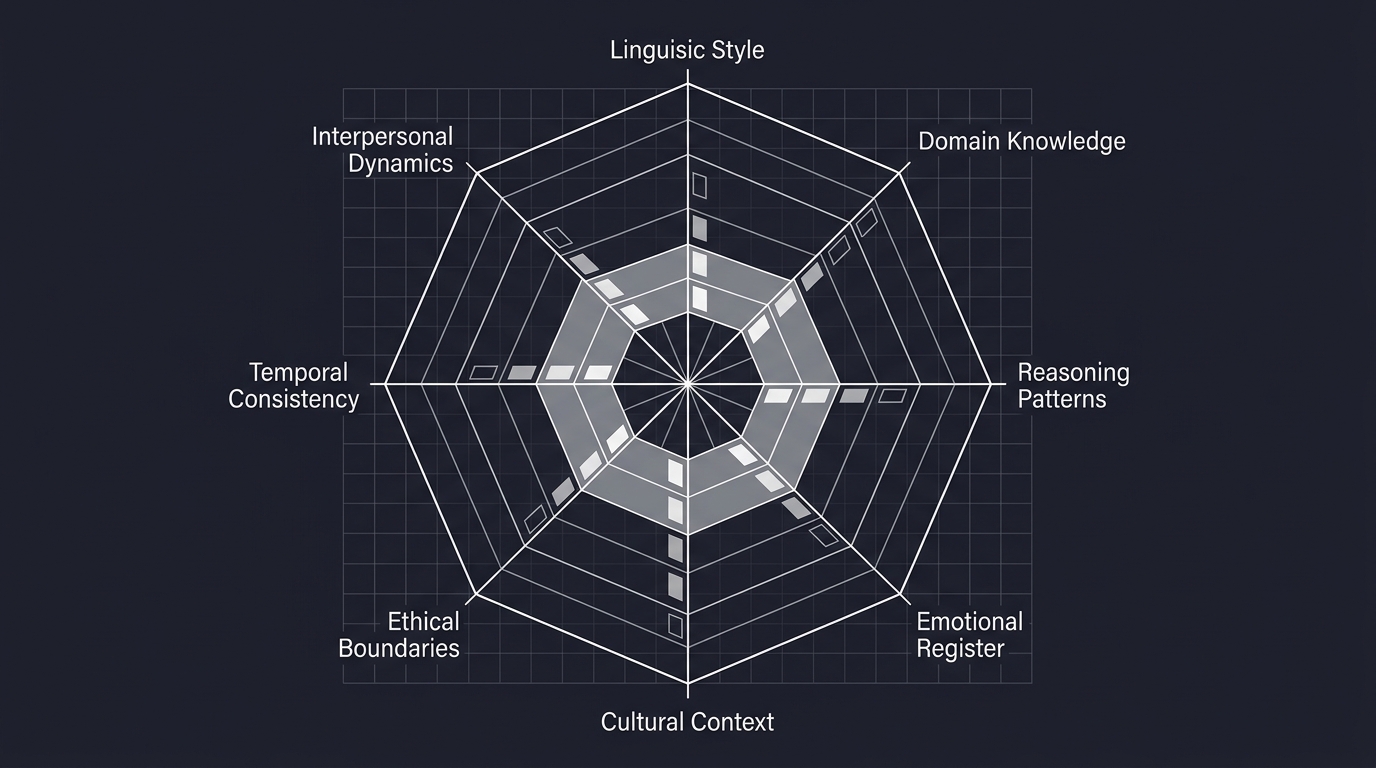
The premise is that current "custom GPT" or "persona prompt" approaches are shallow: they capture surface-level tone but miss the deeper structure of how a specific person thinks, what they know, how they handle ambiguity, and where their blind spots are. Σ1 treats persona replication as an engineering problem with quantifiable dimensions.
Architecture
8-Axis Fidelity Model. Persona fidelity is measured across eight independent axes: linguistic style (vocabulary, sentence structure, register shifting), domain knowledge (what the person knows and at what depth), reasoning patterns (how they approach problems, their cognitive biases, their decision frameworks), emotional register (how they respond under stress, uncertainty, excitement), cultural context (references, idioms, cultural assumptions), ethical boundaries (what they would and would not say), temporal consistency (how their views have evolved over time), and interpersonal dynamics (how they interact differently with different people).
Each axis is scored independently, allowing partial deployments (high linguistic fidelity but limited domain knowledge, for example) and enabling honest reporting of where the persona is strong versus where it approximates.
4-Tier Distribution System. Not all consumers of a persona should get the same fidelity level. The distribution model defines four tiers: full fidelity (the complete persona, restricted access), professional (domain knowledge and communication style, work-appropriate boundaries), public (general interaction capability, conservative boundaries), and reference (read-only, for research and analysis purposes).
OSINT Pipeline. The persona construction process uses open-source intelligence techniques to build the training corpus: public writing, social media history, published interviews, recorded talks, professional outputs. This is not surveillance. It is systematic collection of what a person has already chosen to make public, structured for training purposes.
MCP Server Tier. The deployment architecture uses Model Context Protocol servers to expose persona capabilities as tool-accessible endpoints. This means a Σ1 persona can be integrated into existing AI workflows, called as a tool by other agents, or accessed through standardized interfaces rather than requiring custom integration for each deployment.
What This Demonstrates
AI system architecture that goes beyond "prompt engineering" into structured replication frameworks. The ability to decompose a fuzzy concept ("make an AI that sounds like me") into measurable, engineerable dimensions. Distribution design that considers access control, fidelity degradation, and ethical boundaries as first-class architectural concerns. And integration design (MCP server) that connects to the emerging agent infrastructure ecosystem rather than building in isolation.
This is design-phase work. The architecture is documented, the fidelity model is specified, but the system has not been deployed at scale. The value here is in the thinking, not the running code.
* Images are conceptualized, not the real implementation to protect client's intellectual right