Designing a Sustainable Advisory Model for Mission-Driven Organizations
Designing a Sustainable Advisory Model for Mission-Driven Organizations
The Situation
After completing infrastructure migration work, the organization continued reaching out informally for technical guidance: questions about platform decisions, infrastructure access, evaluating vendor proposals, preparing for government integration meetings. The founding team had begun treating me as their default technical point of contact without a corresponding formal structure or compensation.
This created a classic consulting trap: the most valuable work (strategic framing, architectural recommendations, vendor evaluation) was being given away for free through informal channels, while the only paid work was discrete, transactional tasks.
What I Designed
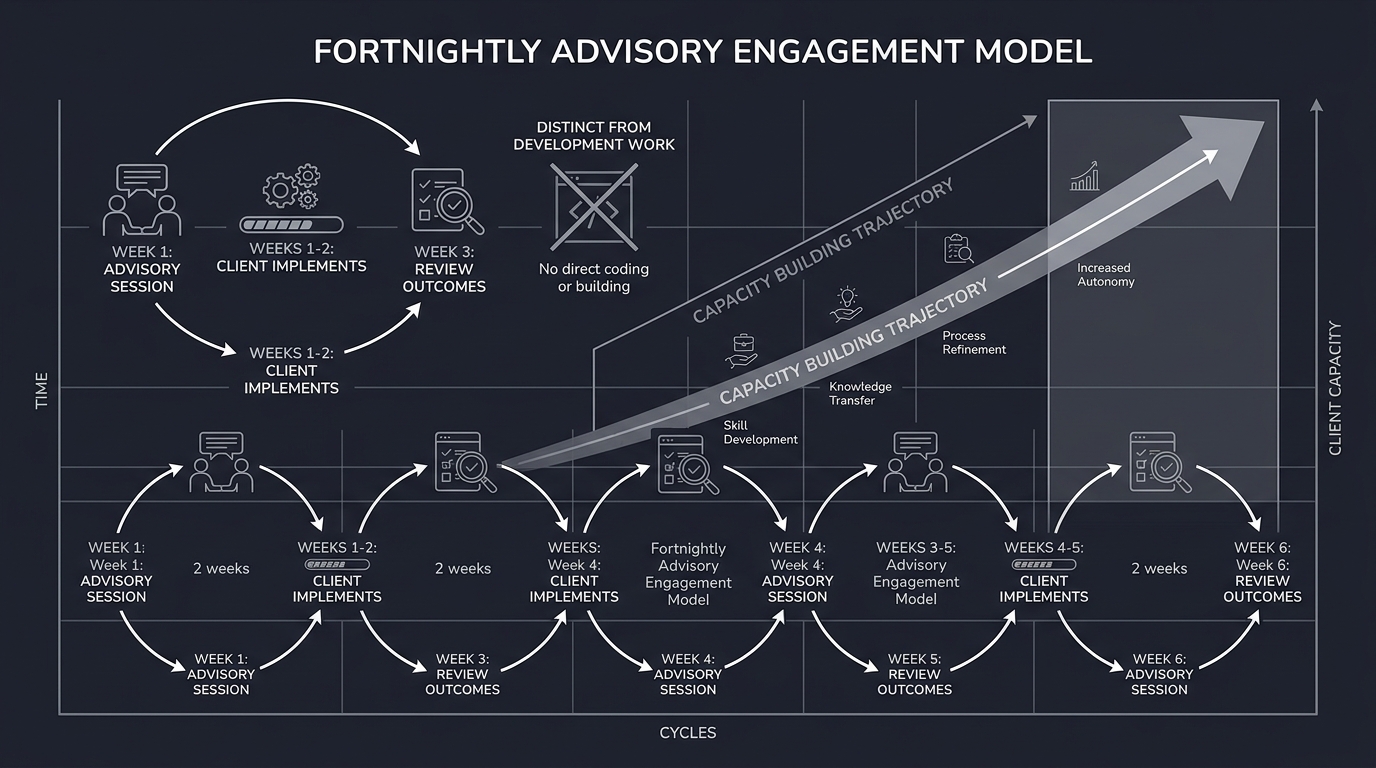
Engagement Model. A fortnightly advisory engagement: structured sessions every two weeks covering technical strategy, infrastructure decisions, and operational priorities. Priced at an accessible rate for a bootstrapped social enterprise, acknowledging their financial constraints while establishing that strategic guidance has a price.
Cycle Structure. Session in Week 1, client implements in Weeks 1-2, review outcomes in Week 3, repeat. This rhythm builds the client's capacity to execute between sessions rather than creating dependency.
Scope Boundaries. Positioned as distinct from development work: no promises of builds, no development scope, purely strategic guidance. Included provisions for discretionary pro-bono proof-of-concept work (capped at approximately 2 hours) when sessions surfaced genuinely valuable experiments.
Documentation. Produced a formal advisory services proposal through DRMSR's proposal platform. Framed the value proposition around the client's own experience: they had already lost time and money making infrastructure decisions without proper technical context.
The Philosophy
Social enterprises deserve well-resourced, properly compensated partnerships, not discounted engagements that compromise quality or the consultant's bandwidth. The consultant's role is to build the client's capacity to make technical decisions independently, not to become their executive function. Informal advisory given for free is a structural problem, not generosity. It devalues the expertise and creates unsustainable relationship dynamics.
What This Demonstrates
Consulting practice maturity. The ability to recognize when an engagement model isn't serving either party and to design something better. Empathy for resource-constrained clients without defaulting to undercharging. Non-technical stakeholder communication with founders from psychology, business administration, and advocacy backgrounds.
Part of a case study. See also: Cutting 85% Hosting Costs and Platform Governance Assessment.
* Images are conceptualized, not the real implementation to protect client's intellectual right